The airport
Tenerife North sits on a plateau in the northeastern corner of Tenerife, wedged between the Anaga mountain range and the volcanic interior of the island. At 2,076 ft above sea level, it regularly disappears into cloud. Trade-wind-driven fog rolls in over the ridgeline to the north and settles on the field, dropping visibility well below minimums. Pilots who fly here know the drill: you brief the approach, check the ATIS, and accept that you might be going to the alternate.
That combination of terrain and weather is exactly what makes GCXO worth modeling properly. An airport this operationally complex can't be represented with flat ortho and a generic mesh. The terrain has to match the published approach charts, the ridgeline has to be where it actually is, and the visual environment has to degrade the way real fog does when you're descending through 400 ft on the RNAV 12.
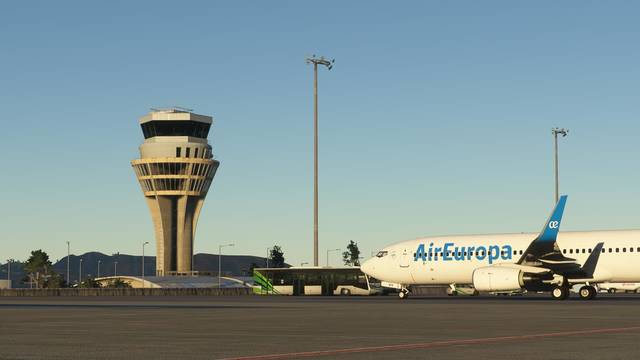
The control tower at GCXO with an Air Europa 737 on the apron
Why we picked GCXO
We wanted an airport where terrain is not just scenery but part of the operational challenge. GCXO is surrounded by rising ground on almost every side. The ridgeline to the north tops out above field elevation, and the volcanic slopes of Mount Teide rise to 12,198 ft to the southwest. On the missed approach for Runway 12, you're climbing out toward terrain that demands accurate modeling down to the meter.
GCXO also has a history. It was the site of the 1977 disaster, the deadliest accident in aviation history. Today it's a busy regional airport handling around 4 million passengers a year, with inter-island traffic, mainland flights, and the occasional diversion from Tenerife South when wind or weather shuts that field down. Modelling it well felt like it mattered.
Terrain and geo data
We started with satellite-derived elevation data and cross-referenced it against published approach profiles. The RNAV (GNSS) approach to Runway 12 has specific altitude constraints that only work if the terrain model underneath matches the charted terrain. A 3-meter error at the wrong point can shift the sight picture on short final or create a false sense of clearance on the missed approach.
We validated every approach path against published Jeppesen and AIP plates. The terrain model had to produce the correct visual picture at decision height, not just look reasonable from altitude.
The surrounding terrain was built with custom mesh. The default simulator mesh in the Tenerife area tends to smooth out the ridgeline and flatten the coastal cliffs. We replaced that with higher-resolution data that preserves the sharp drop-off on the northern side of the airport, where the land falls away steeply toward the coast. That cliff line is a real visual reference for pilots. If it's not there, the approach doesn't feel right.
Modeling the airport
On the ground, GCXO is a working regional airport with a single terminal, cargo facilities, fire station, and the usual collection of service roads, aprons, and taxiways. We modeled from satellite imagery, airport diagrams, and photo reference. The terminal building is based on its actual floor plan and facade proportions.
Ground markings were placed according to the published airport diagram. Taxiway signage follows standard ICAO conventions, and the PAPI for both runway ends is positioned and angled per the published data. We built the ILS critical area markings for Runway 30 and the holding positions at intersections A through E.
Vegetation around the field is sparse but specific. The plateau has low scrub, and the areas between the taxiways and the perimeter road are rocky with patchy grass. We avoided the simulator default of uniform green ground cover and matched the actual terrain coloring to the dry, volcanic soil you see on the island.
Low visibility
GCXO's defining characteristic is the cloud. The airport sits right at the altitude where the trade-wind inversion layer traps moisture, and conditions can change quickly. An approach that starts in clear air can end with the runway lights barely visible at 200 ft.
In the simulator, we made sure the RNAV and ILS approach lighting is accurate in position and intensity so that the transition from instruments to visual happens at realistic ranges. When you break out at 300 ft on the RNAV 12, you should see what a pilot actually sees: the approach lights first, then the threshold, then the runway stretching away toward the hills.
We also spent time on the runway surface texturing at low angles. When you're at decision height looking down the runway in reduced visibility, surface detail is what tells your brain the runway is there. Flat textures wash out. Ours hold up under those conditions because we built them with that exact viewing angle in mind.
What we delivered
- Custom terrain mesh covering GCXO and the surrounding 15 km, replacing the default with data validated against published approach profiles
- Full airport model including terminal, cargo, fire station, and ground service equipment
- Accurate RNAV (GNSS) and ILS approach lighting positions and glidepath angles
- Ground markings, taxiway signage, and holding positions per the current airport diagram
- PBR surface materials that hold up under low-angle and low-visibility viewing conditions
- Vegetation and ground cover matched to actual terrain coloring from satellite and photo reference
- Published for MSFS 2020 and MSFS 2024 through Just Flight
Lessons for the B2B side
GCXO reinforced something we've applied to every project since: the terrain model is not decoration. For any airport where approaches interact with rising ground, the terrain mesh has to be accurate enough to produce correct visual cues at decision height. That's a different standard than "looks good from 5,000 ft" and it requires validation against published instrument procedures.
If you operate or manage an airport with complex terrain or challenging approaches, the kind of digital twin we built for GCXO can serve as a training tool, a planning reference, or a way to visualize proposed changes to approach procedures. The same pipeline and methodology we use for published consumer scenery applies directly to B2B projects.